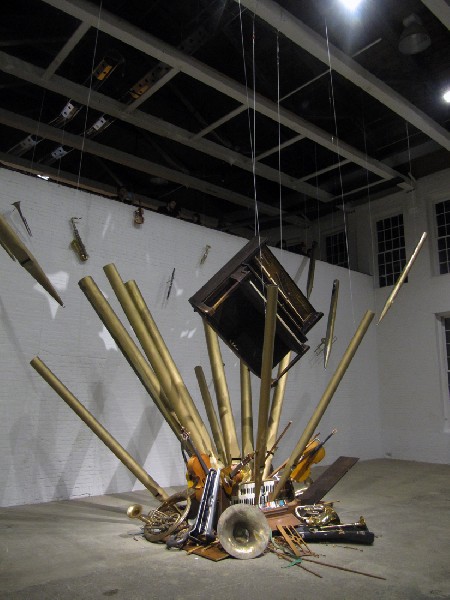
I have to respect someone who can put this much work into an exhibit, regardless of whether or not they have a higher concept.
Art & Philosophy
Sunday, April 8, 2012
In defense of ridiculous art
It is impossible to take so much as a passing glance at modern art without acknowledging that some of it is totally ridiculous. Unfortunately, I love ridiculous art. My favorite type of ridiculous art is visually impressive, huge, impractical installation art. Mass MoCA is pretty good at supplying it. Still, I think there are certain virtues to this type of art. They take a lot of work to compose and create. Merely setting up an exhibit like the "Afrofuturism" one currently on display took weeks if not months. There was an exploded pipe organ in it -- there's no way that didn't take some work.
Good versus bad art
I am too occupied with trying to figure out what makes art good or bad. I am trying to form my taste, but it's entirely based in what I like in the moment. I don't really think about wide terms. I don't look at a piece of pleasant abstract art and decide I now like abstract art. Rather, I have been trying to keep an open mind and find out more about myself and about art through a lot of fresh experiences. I like to see new art. Some modern art can be silly or even outright stupid, yes, but I enjoy a lot of it. Concept art can be pretty cool.
I always try to keep an open mind when I see a new art piece because so much of what you get out of a work of art is the energy and thought you are willing to put into viewing it. A lot of it depends on the artist, but a lazy viewer can ruin a painting for themselves just as easily as a bad artist, and an unregarded painting can have certain qualities of excellence that a really enthusiastic, interested viewer will bring to the surface.
Dickie -- Question
On page 431 in our book, Dickie claims that institutional formality and
rules for art “would threaten the freshness and exuberance of art.” In what
ways would rules and formalities do this? In what ways could these things
promote and sharpen creativity? Is it possible to conceive of art without a
certain set of rules and expectations?
While there are definitely rules for art, and those rules are important, a person who can break them and get away with it ought to do so (which is what my 10th grade English teacher told me). We see this through all kinds of art, especially modern art. Good examples can be seen in poetry. Poetry and English in general follow a set of specific rules. The English language is governed by grammar. If a person writes a poem with unintentionally bad grammar, we do not appreciate the poem. It has been badly executed because the person writing it did not follow the rules and does not know how to write within them. However, we can't say that bad grammar is the mark of a bad poem. e.e. cummings is a Harvard-educated poet. His work is widely regarded as okay at the very least. He clearly knows how grammar works, and, knowing how the rules go, chooses to work outside of them.
Buffalo Bill's
defunct
who used to
ride a watersmooth-silver
stallion
and break onetwothreefourfive pigeonsjustlikethat
Jesus
he was a handsome man
and what i want to know is
how do you like your blueeyed boy
Mister Death
Maybe not anyone can break the rules. You have to first understand why the rules exist and how
to operate inside them. Once you can do that, though, breaking them is fair game, and some of
the most successful artists in history have been people skilled enough to do just that.
Sunday, March 25, 2012
Domesticity
On the subject of living artifacts, it really does make sense that a dog is an artifact of human civilization. They never would have come to exist without us, we breed them to be as useful as possible, and we have created more diversity through breeding in that gene pool than is seen in almost any other single animal on earth. An experiment was done in Siberia which really underscored how complex the process of breeding for domesticity is. The researchers were trying to create a domesticated fox that could be sold as a viable, safe pet. In order to do this, they had to capture a very large sample of foxes and choose the tamest, calmest, and most docile among them, then get those foxes to reproduce and go through the sorting process again with the kits. Even if they hit upon the tamest fox ever bred, nobody can say yet if they will be able to find the trait for domesticity, not just repressing the instinct to attack but actually wanting to be part of the family "pack" and take orders from an alpha.
Artifacts
The discussion in class really made me think about artifacts and what measure they can be defined by. I tend to think of artifacts as historical objects which are both created by and indicative of culture at a certain time period. Thinking of people as artifacts was interesting because that is really exactly what people are. Mostly, they are products of their environment. Meeting a child can tell you more about his parents than a painted vase could tell you about Sumer.
If we make our children into artifacts of ourselves, then many things are artifacts. We alter the very water we drink, the genetics of plants and animals, every aspect of our environment. We've changed the world to suit us like breaking in a mattress.
Thursday, March 22, 2012
Question
via braden: Carlson
seems to imply that for each setting there is a "right" mindset to have and
way to view the landscape/ flower/ summer afternoon.
Is this true? Or is it possible that there are multiple "right" ways to
view a natural environment? Or is there no "right" way and perhaps only
shades of appreciation?
I think there is a vague "right way" to view a natural environment. It's possible, but implausible, that someone would totally misdirect their attention when in a natural environment. However, I think there are probably a lot of ways to appreciate nature, and people tend to appreciate different aspects more than others. Maybe Carlson is saying that we shouldn't focus in on one thing, but allow ourselves to absorb all of nature as a full experience. He quotes Yi-Fu Tuan on the ideal way to view nature, saying:
"An adult must learn to be yielding and careless like a child if he were to enjoy nature polymorphously... feel free to stretch out on the hay beside the brook and bathe in a meld of physical sensations... Such an environment might break all the formal rules of euphony and aesthetics, substituting confusion for order, and yet be wholly satisfying." (543)
Sunday, February 26, 2012
via braden: How does Clive Bell establish that the aesthetic world is a "world with emotions of its own" in which "the emotions of life find no place" (267)? Do you think he explains this fully? Can you think of reasons or examples as to why he is right/wrong?
Bell seems to be identifying the realm of aesthetic emotions as a separate, higher plane than the emotions of normal, everyday life. When he says that he feels an aesthetic emotion, it seems to be in the way that someone might say they were "moved" by a painting, because it doesn't connote a specific emotion, just that an emotion was evoked. I don't really think Bell explains his concepts clearly because of the circularity and vague definitions of aesthetic emotions/significant form. He says that people who feel aesthetic emotions are the ones best qualified to judge art, but he does not seem to be able to pin down a specific definition of what the emotion is. This makes sense because he has to acknowledge, at some level, that art is subjective and shifts depending on the person viewing it. I don't know whether or not Bell can be proven wrong, or even if an example can be provided against him. His tastes seem to be heavily informed by his preference for abstract art. As someone who likes to see storyline and reference used within artwork, I can't really appreciate that aesthetic, but he is entitled to his opinion. I don't really like his way of expressing it, though -- his whole argument seems to be based totally on his own opinions and definitions.
Subscribe to:
Comments (Atom)